Reporter Name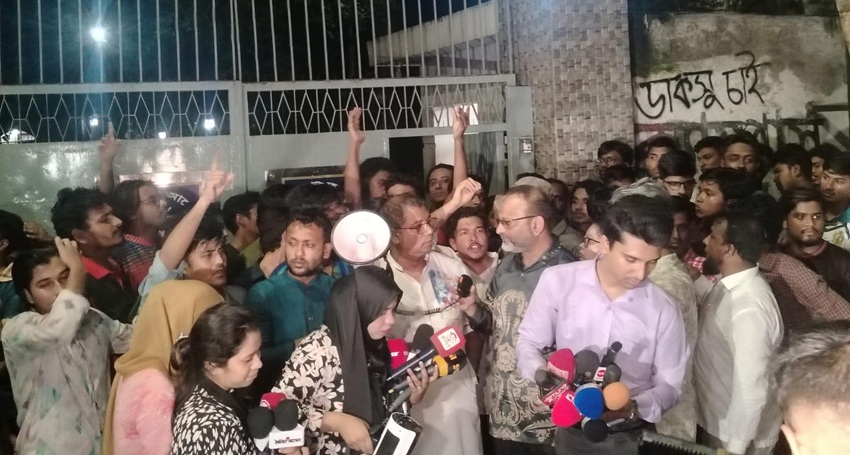
The controversial move involved 593 student appointments and triggered fierce resistance from residents demanding complete separation of political activities from academic residential life.
Vice-Chancellor Professor Dr Niaz Ahmed Khan was forced to address protesting students at 2AM on Friday, reaffirming that student politics remains banned in all residential halls under policies established on July 17, 2024. However, students rejected his announcement, presenting six comprehensive demands including immediate dissolution of all political committees within 24 hours and formal apologies from hall administrators.
The crisis deepened when allegations emerged that nearly two dozen former Bangladesh Chhatra League (BCL) activists had infiltrated JCD’s newly formed committees. Investigative findings prompted immediate dismissal of six leaders, including conveners and joint conveners from multiple halls, after verification revealed concealed information about their political backgrounds.
JCD President Ganesh Chandra Roy Sahos and General Secretary Nahiduzzaman Shipon announced appointments across 18 residential halls through official press release on Friday. The comprehensive reorganisation demonstrated JCD’s strategic emphasis on strengthening grassroots network within Bangladesh’s premier university, marking significant expansion of the student organisation’s campus presence.
Committee sizes varied considerably across different halls, reflecting diverse accommodation capacities and organisational requirements. Male residential halls dominated appointments, with Haji Muhammad Mohsin Hall leading at 61 members, followed by Bijoy Ekattor Hall and Sheikh Mujibur Rahman Hall with 54 members each. Muktijoddha Ziaur Rahman Hall appointed 51 students, whilst Shaheed Sergeant Zahurul Haq Hall established 56-member committee.
Female halls demonstrated notably smaller committee structures. Rokeya Hall appointed merely 8 members, whilst Shamsun Nahar Hall formed 5-member committee. Sheikh Fazilatunnesa Mujib Hall operated with minimal 4-person structure, and Bangladesh-Kuwait Maitree Hall established compact 3-member leadership team.
Serious allegations surfaced claiming former Chattra League activists had secured positions within the 593-member committees, prompting leadership to establish probe committee with three-day deadline for findings. The infiltration claims mirrored similar issues from November 2024, when JCD’s central committee dismissed six DU unit leaders following university committee infiltration allegations.
Several appointees holding senior joint convener positions had previously served as secretarial members in Chattra League committees. Critics claimed individuals who previously mocked BNP Chairperson Begum Khaleda Zia had obtained committee positions, whilst long-standing activists and July movement participants were allegedly overlooked.
Nepotism allegations centred around Sir A.F. Rahman Hall, where General Secretary Nahiduzzaman Shipon allegedly appointed his younger brother, Md. Mahdijjaman Jyoti, as member secretary despite having no prior party experience. Shipon defended selections, stating: “Since September–October last year, those who filled our primary membership forms and remained with us were considered.”
Notable infiltrators included Rakibul Hasan Sourav, former vice-president of Biology Faculty BCL; Zakia Sultana Alo, linked closely to prominent BCL leader Sazia Rahman Silvi; and Roman Mia and Joni Pramanik, both accused of strong ties with BCL politics. Photos circulating on social media confirmed several committee members’ BCL affiliations, including participation in BCL rallies and election campaigns.
Tensions erupted at Friday’s midnight as hundreds of students from multiple halls converged on Teacher-Student Center (TSC) area for protest marches. Female students from five major dormitories, including Kabi Sufia Kamal Hall, Shamsunnahar Hall, and Rokeya Hall, staged demonstrations within their residential premises, whilst male students from Haji Muhammad Mohsin Hall and A.F. Rahman Hall led processions.
Students chanted powerful slogans demanding “Hall committee-r biruddhe direct action” (Direct action against the hall committee) and “Gupto committee-r biruddhe direct action” (Direct action against the secret committee), highlighting widespread opposition to political infiltration of their living spaces.
Students at Bangamata Sheikh Fazilatunnesa Mujib Hall secured signed statement from their hall provost, demanding suspension of Chhatra Dal hall committee by 11:00 PM. At Rokeya Hall, students issued decisive 30-minute ultimatum to ban all forms of student politics whilst simultaneously boycotting politically-donated items including water filters, vending machines and rubbish bins.
Student Tanjila Tasnim declared: “Keeping water filters donated by Chhatra Shibir and gifts from other political organisations in the hall can pave the way for student politics to enter our living spaces.”
Following prolonged disturbances, Vice-Chancellor Professor Dr Niaz Ahmed Khan announced that decisions taken on July 17 last year regarding student politics prohibition would remain in effect. Individual hall administrations would take necessary actions under this policy, whilst he would discuss matters with recently announced Chhatra Dal committees.
However, protesting students rejected his announcement, demanding complete end to all hall-based politics. Students presented six-point demands: VC must explain why committees were announced; all existing secret and public committees must be dissolved within 24 hours; university must provide comprehensive roadmap completely banning political activities; hall provosts must apologise; DUCSU elections must be held promptly.
JCD central committee responded by relieving six DU leaders for suppressing facts. Those dismissed included Mosaddek Al Haque Shanto and Rakibul Hassan Saurav from Dr Muhammad Shahidullah Hall; Nitu Rani Saha from Shamsunnahar Hall; Razu Sheikh from Muktijoddha Ziaur Rahman Hall; and Ahmed Jabir Maham and N S Saymon from Haji Muhammad Mohsin Hall.
The crisis gained additional complexity when Umama Fatema, former member secretary of Student Federation and current DUCSU VP candidate, submitted petition demanding ban on all political activities except leftist student organisations in residential halls. Her petition, submitted to Kabi Sufia Kamal Hall provost, went viral on social media, drawing criticism for apparent double standards.
Hamza Mahbub, organiser for Jatiya Nagorik Party (NCP), wrote: “Umama Fatema wants no politics in the hall except leftist politics. What is this? This is hypocrisy at its peak! Everyone is against politics in the halls and academic areas, but she is only against all politics except leftist politics.”
This unprecedented student mobilisation represents significant challenge to traditional political structures within the country’s premier university, as students demand complete separation of academic residential life from political activities. The situation reflects broader tensions in Bangladesh’s educational landscape, where student political organisations continue struggling for influence despite official prohibitions.