Reporter Name
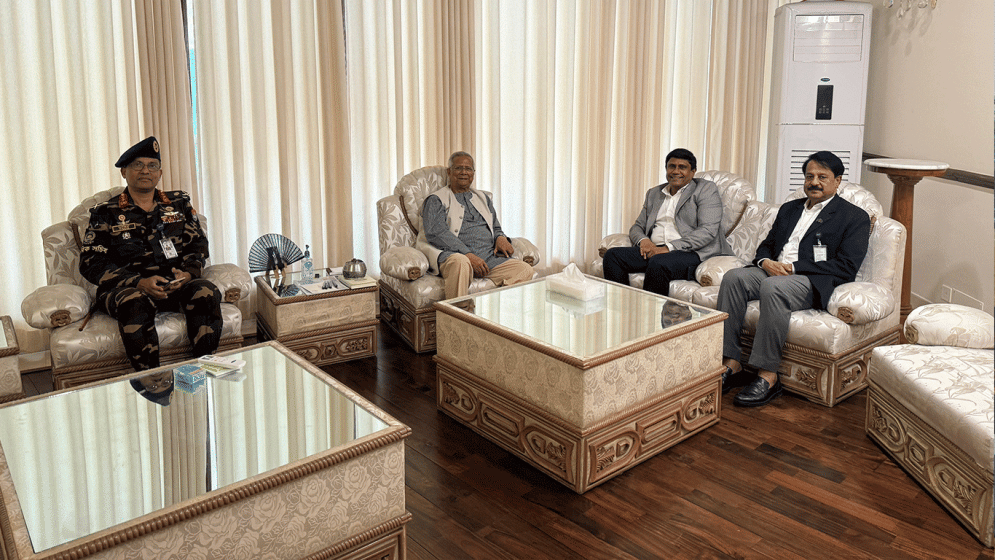
Chief Adviser Professor Muhammad Yunus has confirmed that Bangladesh will hold national elections in February 2026 and announced his complete withdrawal from political life once the democratic transition is complete.
In a landmark op-ed published Thursday in Deseret News (USA), Yunus recounted the historic August 2024 youth-led uprising, the formation of the caretaker government, and the far-reaching reforms underway in Bangladesh’s political and economic institutions.
“I have made it clear: the national elections will be held in February,” Yunus wrote. “I will not hold any position in the government that follows. My role ends when democracy is restored.”
Yunus described last year’s uprising as a pivotal moment in Bangladesh’s modern history—led not by politicians but by students and young people demanding dignity, justice, and democracy.
“A year ago this month, thousands of courageous students, backed by millions from all walks of life, ended a long era of authoritarian rule,” Yunus wrote. “Their peaceful protests were met with brutal repression—but they stood firm. On August 5, the dictator fled.”
In the days that followed, with the country on edge, student leaders urged Yunus to head a transitional administration. He accepted—reluctantly at first—out of respect for the sacrifices made.
“On August 8, 2024, I was sworn in as Chief Adviser, alongside a council of civil society leaders. Our mission: to stabilize the nation and create the conditions for free and fair elections.”
Yunus described the movement as the world’s first ‘Generation Z’ revolution—starting with demands for employment reform and swelling into a broader national call for reform and renewal. “They didn’t wait for permission. They acted—because they knew the future could not wait.”
Since taking office, the Yunus-led caretaker government has undertaken major reforms, working to stabilize an economy on the brink of collapse, restore public institutions, and retrieve stolen public funds.
“We were too busy rebuilding the economy, restoring institutions, and recovering stolen wealth to realize how closely the world was watching.”
Yunus said the interim government inherited a nation in deep crisis:The economy had nearly collapsedForeign reserves had plungedCivil service was deeply politicizedLaw enforcement had abandoned its dutiesAn estimated $10–15 billion had been siphoned annually over 15 years, according to Transparency International BangladeshSince then, key progress includes compensation for families of those killed or injured in the uprising, asset recovery with international cooperation, merit-based reforms in civil service and restoration of neutrality in the military and police.
Yunus praised the military for its restraint during the protests and its professionalism since. Under Yunus, Bangladesh has shifted its foreign policy focus toward regional stability and strategic global partnerships.
“As the eighth most populous nation, Bangladesh has a responsibility—and an opportunity—to be a pillar of peace and prosperity in South and Southeast Asia.”
He highlighted recent engagement with U.S. Secretary of State Marco Rubio as a “positive step” toward expanded trade and cooperation, and thanked global partners—including the UK, Japan, the EU, World Bank, and United Nations—for their continued support.