
 Staff Reporter :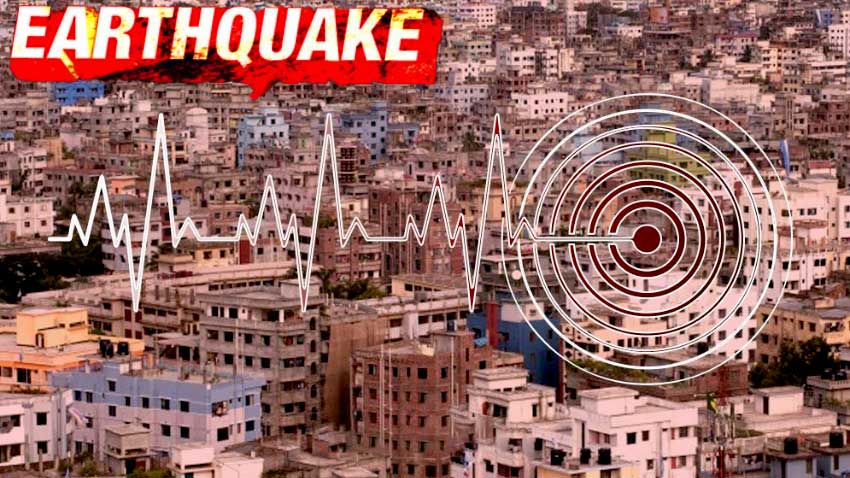
According to a RAJUK Urban Resilience Project survey, Dhaka now has approximately 2.145 million buildings. A 6.9-magnitude earthquake along the nearby Madhupur Fault in Tangail could cause several hundred thousand structures to collapse due to rampant building-code violations, unauthorized constructions, and the fact that nearly 95% of buildings were erected without approved designs.
Data from the Detailed Area Plan (DAP) show that between 2006 and 2016, an average of 95,000 structures were built annually, but only 4,147 received RAJUK approval—meaning over 95% of construction bypassed oversight.
A city built on risk
Many structures under Dhaka North and South City Corporations were built 20–30 years ago, often without proper material testing or adherence to approved designs. Experts warn that even moderate quakes could cause serious damage.
Friday’s 5.7-magnitude earthquake damaged 14 buildings across Dhaka, according to district relief officer Salahuddin Al-Wadud. Affected areas include Malibagh Chowdhury Para, Armanitola, Swamibagh, Banani, Bashundhara, Kalabagan, Nadda, Banasree, Mohammadpur, Khilgaon, Badda, Madhubagh, and the vicinity of Hazrat Shahjalal International Airport.
Lack of oversight and enforcement
Urban planners say RAJUK lacks both manpower and advanced equipment to properly assess structural safety. The agency does not even have a complete list of unauthorized buildings or those constructed by encroaching on canals, wetlands, or rivers. Millions of structures may be at risk, and new ones continue to rise while hazardous buildings remain standing.
Experts insist that enforcing the National Building Code is essential to preventing a large-scale disaster.
BUET civil engineering professor Mehedi Ahmed Ansary warned that Friday’s tremor may have been one of several precursors to a major earthquake. The damage from a relatively moderate quake indicates the devastation a magnitude 7 event could unleash—particularly if its epicenter lies within 100 kilometers of Dhaka.
Dr Abdul Latif Helali, former project director of the Urban Resilience Project, noted that many buildings in and around the city lack minimum structural standards. A risk-sensitive land-use plan based on soil testing has been drafted, and an Urban Safety and Resilience Institute is under development to evaluate structural stability.
Planning failures, political influence, and corruption
Bangladesh Institute of Planners President Dr Adil Mohammed Khan said the latest quake has heightened public awareness of the looming danger. He emphasized that Dhaka lacks adequate open spaces for emergency evacuation. Existing regulations—including the National Building Code, Building Construction Rules 2008, and the DAP—are undermined by political interference, corruption, and weak enforcement.
He recommended: strict enforcement of building codes, establishment of Bangladesh Building Regulatory Authority, banning construction in low-lying areas, protecting water retention zones, publishing lists of hazardous buildings, evacuating dangerous structures immediately.
Policy changes and revised urban plans
RAJUK’s new draft policy proposes legalizing buildings constructed without approved designs—but only if they comply with the national code and master plan—subject to fines of three to five times the design approval fee. Buildings violating critical rules will face action. The draft has been submitted for review.
RAJUK Chairman Md Riazul Islam confirmed that officials have identified 3,382 illegal buildings, with action underway. Teams have been deployed to inspect cracked structures after Friday’s quake.
The government has also approved amendments to the DAP, reducing Dhaka’s planning area from 275 blocks to 68 and raising maximum population density from 250 to 300 people per unit. Buildings up to 10–11 floors will now be allowed in areas previously capped at five floors. Occupancy certificates will be valid for life, rather than requiring renewal every five years.
History of seismic activity
Records show at least two earthquakes above magnitude 4 struck near Faridpur over the past 15 years. The strongest quake near Dhaka in recent decades was a 5.1-magnitude tremor in Narayanganj in 2010. Major earthquakes hit the Madhupur Fault in 1822 and 1918, while a 7.5-magnitude quake struck Manikganj in 1885.
Friday’s 5.7-magnitude quake originated in Narsingdi’s Madhabdi, uncomfortably close to the capital.