Reporter Name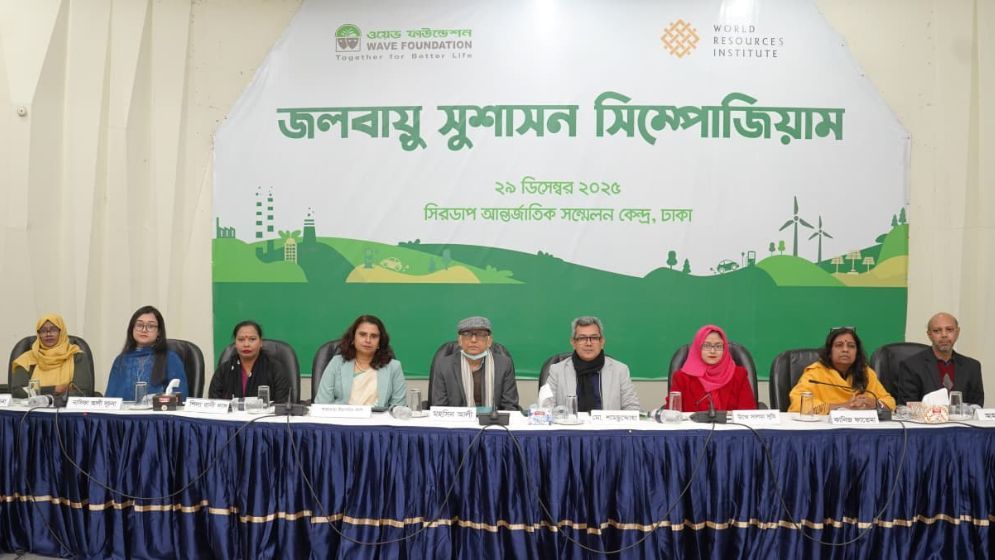
Climate change activists on Monday said that the union parishads are neither capable nor ready to reduce climate risks even though the climate change-induced disasters hit Bangladesh very often.
The activists also said that the people of the climate change-affected areas have no voice in climate change mitigation talks and damage management plans for them, which is risking climate justice.
To this end, they outlined the findings of new research at a climate justice symposium held at the CIRDAP auditorium in the capital, organized by the non-profit Wave Foundation.
The Center for Social Research (CSR) conducted the research in coastal districts of Patuakhali and Barguna. The researchers interviewed 960 community members, and 640 officials from four upazilas, 32 unions, and 288 wards of the two districts.
CSR Research Director Ahmed Borhan revealed the findings, saying that the lowest tier of the local administration, the union parishads, has no preparation regarding climate change-induced natural disasters.
He said, “The disaster management committees at Union Parishads are inactive and the ward meeting is irregular. Residents under the unions are not aware of the budget, and they think that the project is not implemented in an accountable and transparent manner.”
Speaking on the occasion, the chief executive of the Center for Participatory Research and Development (CPRD), Md Shamsuddoha, said, “There is a gap in the implementation of the climate action plan. Scientists suggest a plan, but the politicians implement the plan in their own way without consultation with the climate victims. Even during the drafting of the climate action plan, the victims are not given a voice as these are prepared through consultants.”
He suggested that the plan and implementation be done in an integrated way to ensure the best use of the climate funds.
Chairman of the Boro Bigai Union, Alomgir Hossain, said that the union parishad does not get adequate funds for delivering its regular services, let alone implementing the climate action plan.
Chairman of Lalua Union under Kalapara Upazila said that after the construction of Payra port and power plants, the climate change impact worsened. Farmers lost their agricultural land while fishermen lost their livelihood as the projects narrowed down the catchment areas and sanctuary.
Founder and Executive Director of Wave Foundation, Mohsin Ali, said that Bangladesh cannot use the climate funds properly to tackle the effects of climate change.
He said, “We are the 7th most vulnerable nation to climate change. The countries that are major players in climate change are not taking equal responsibility to address the climate loss and damage. Besides, the funds that are available are not being used properly. Now, we have to increase the capacity and budget for the union parishad.”
Speaking as the chief guest, Shahanara Yasmin Lily said that people of the coastal areas like Bagerhat have been suffering from a lack of drinking water due to high salinity, which needs to be addressed immediately.
Journalist Raihanul Ferdous said that the youth must come forward in different sectors to realize the legal rights of the climate victims.