Reporter Name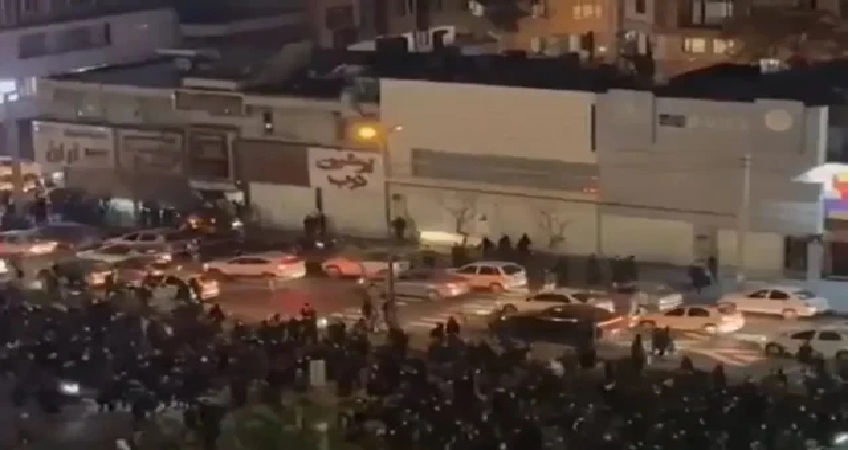
Videos shared online before communications were shut showed crowds chanting slogans including “Death to the dictator” and “Death to the Islamic Republic” in Tehran and other cities, with fires burning in the streets, reports DW English.
The Norway-based Iran Human Rights NGO reported that 45 demonstrators have now been killed by Iranian security forces since the unrest began in late December.
Another report by the US-based Human Rights Activists News Agency (HRANA) said more than 2,200 people have been arrested.
Iranian state media acknowledged the protests on Friday, admitting to casualties without further details, and accused “terrorist agents” backed by the United States and Israel of inciting violence.
What do we know about the protests in Iran?What do we know about the protests in Iran?
The demonstrations began late last month with protests in the capital, Tehran, over Iran’s economic woes and plunging currency. They have since morphed into a movement that is challenging the legitimacy of the country’s ruling Islamic government.
On Thursday, mass protests were held in Tehran. According to images on social media verified by the AFP news agency, protesters massed on Ayatollah Kashani Boulevard, a key avenue in the northwest of the Iranian capital.
Protests were also reported in other areas, such as Kurdish regions in the western part of the country, Tabriz in the north and the holy city of Mashhad in the east.
Reza Pahlavi, the son of the last shah of Iran before the 1979 Islamic Revolution, has thrown his support behind the protests, which are now on their 11th day.
Pahlavi had called Iranians to take to the streets at 8 p.m. on Thursday and Friday.Demonstrators on the ground have voiced chants in support of the exiled Pahlavi Dynasty.
“Great nation of Iran, the eyes of the world are upon you. Take to the streets, and as a united front, shout your demands,” Pahlavi posted on X.
In response, Iranian security forces have been accused of opening fire on the protesters. Internet monitoring organization Netblocks on Thursday reported that Iranian authorities have severely curbed internet access in the country as the demonstrations continue.
Iranian President Masoud Pezeshkian, a reformist, said authorities should exercise “utmost restraint” when handling the demonstrations. He called for “dialogue, engagement, and listening to the people’s demands.”
Germany, EU express fresh support for demonstrators Germany, EU express fresh support for demonstrators
German Foreign Minister Johann Wadephul said he condemns “the excessive use of violence against peaceful demonstrators and calls on the Iranian authorities to adhere to their international obligations.”
European Parliament President Roberta Metsola also expressed solidarity with the protesters.
The world is once again witnessing the brave people of Iran stand up,” Metsola said in a video post on X. “Europe stands by their side.”
US President Donald Trump has previously suggested that the US military could intervene if Iran “violently kills peaceful protesters.”
During an interview with conservative radio host Hugh Hewitt on Thursday, Trump repeated his threat that the US would strike “very hard” if Iran “starts killing people.”
Trump had ordered the US armed forces last year to attack Iran in an attempt to dismantle Iranian nuclear enrichment capabilities.
Israeli Prime Minister Benjamin Netanyahu called the protests a moment for Iranians to “take their futures into their hands.”
Meanwhile, Supreme Leader Ayatollah Ali Khamenei has declared that Iran “will not yield to the enemy.”
Largest demos since ‘Woman, Life, Freedom’ movement
This is one of the most precarious moments of Khamenei’s decadeslong rule and the largest protest in the country since 2022 death of Kurdish-Iranian woman Jina Mahsa Amini in police custody.
Iranians say there is discontent among the youth with the country’s political system, social restrictions and foreign policy.
“The younger generation no longer believes in revolutionary slogans — it wants to live freely,” a former senior government official said.
“I just want to live a peaceful, normal life … Instead, they [the rulers] insist on a nuclear program, supporting armed groups in the region, and maintaining hostility toward the United States,” Mina, a resident of Kuhdasht in western Iran, told Reuters by phone.
“Those policies may have made sense in 1979, but not today. The world has changed.”