BSS
BSS 
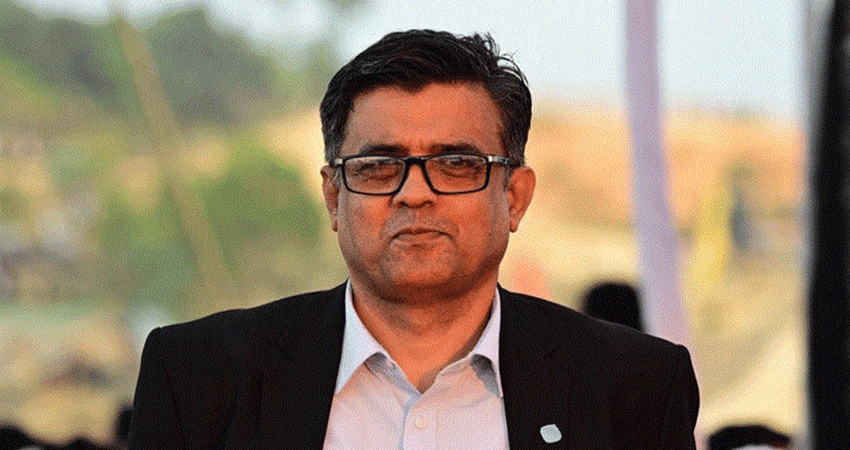
Muktijoddha Maitri Awardee Pakistani origin Swedish judge Syed Asif Shahkar has wished to be interred in Bangladesh, a country for which he was imprisoned and tortured by Pakistani rulers during its Liberation War in 1971.
“I am now 72 years old. I don’t know how long I will be alive. But as a well-wisher of Bangladesh, I want to be buried in its soil,” said Shahkar.
Taking to BSS over phone in the month of Victory, he said he had already written a letter to Prime Minister Sheikh Hasina in December of 2015, expressing his final desire.
He said in his letter he sought Bangladesh citizenship but he has not yet been able to know whether Prime Minister Sheikh Hasina received his letter.
He was born in Panjab and in 1971, he was 22 years old.
Young Shahkar protested, held rallies, wrote poems and distributed leaflets in support of Bangladesh Liberation War, he said, adding, as a result, he became hated by his family, society and the people of Pakistan.
He also said he was general secretary of Punjab Students’ Union and a section of people of West Pakistan protested the ruthless and brutal genocide of the Pakistani regime called ‘Operation Search Light’ on the then East Pakistan (now Bangladesh) on the dark night of March 25, 1971.
“I was imprisoned as a ‘traitor’. During the nine months of Liberation War, I endured mental and physical tortures in Pakistan prison. But I did not go against Bangladesh. I was released from captivity after December 16, 1971 with the victory of Bangladesh,” he recalled.
Shahkar said, “If Bangladesh hadn’t achieved independence, I could not have been released from the prison. I would have been sentenced to death or life in prison in Pakistan”.
Later, he worked as a producer in Pakistan Television for few days at Lahore but he could not stay in Pakistan for long with recognition as ‘Kulangar’ in his own country.
In 1977, he went to Sweden for political asylum. He started his new struggle for living. Later he was appointed and started working as a judge of the High Court Division of Sweden.
After 41 years of independence, Justice Shahkar came to Bangladesh to receive the Liberation War Friendship Award in 2012 at an invitation of the Bangladesh government. Late President Md. Zillur Rahman and Prime Minister Sheikh Hasina presented the award to him on December 15, 2012.
Shahkar said, “I might not express my love to Bangladesh during my life time. I was so touched and emotional to get overwhelming love, respect and goodwill what I received during my stay in Bangladesh. When I left for Sweden I guessed that leaving Bangladesh will be my lifeless departure and my soul will remain behind”.
“I like to think of myself as a Bangladesh citizen, not Pakistan. I applied for Bangladesh citizenship so that after my death he could be buried in the soil of Bangladesh,” he added.
In a long letter of 770 words to the prime minister, Shahkar expressed his love for Bangladesh, the people of Bangladesh, as well as heartfelt desire to be buried in the soil of this country.
In the letter, Shahkar quoted Prime Minister Sheikh Hasina as saying, “A foreigner who supported the War of Liberation is also a freedom fighter” and said her words have guided him to proceed and directly knock at her door.
“We were honored to have received the Friends of Bangladesh Award. When a freedom fighter of Bangladesh can be citizen of Bangladesh, live here, own a home, then being foreigner who supported the war of freedom why I cannot be buried here like other deceased freedom fighter of Bangladesh. Why I cannot be Citizen of Bangladesh? Why I cannot have my own home in Dhaka like a Bangladeshi freedom fighter,” he said in his letter to Sheikh Hasina.
Mentioning himself as a foreign freedom fighter of Bangladesh, Shahkar applied for Bangladesh citizenship and the privilege of a citizen including the facility of burying him in Bangladesh. He also expressed his desire to work for Bangladesh.
Drawing the attention of the premier, he wrote, “I not only believe but I am sure that you will consider my humble request in earnest.”
The retired justice is still working for Bangladesh despite staying living in Stockholm. He is also vocal in demanding justice for the brutal genocide that the then Pakistani ruler committed in Bangladesh in the 1971 Liberation War.
After the World War II, no other country in the world had such a large-scale genocide and despite that, the United Nations has not yet recognized the genocide in Bangladesh occurred in 1971, he said.
On October 3, 2022, a discussion meeting was held at the headquarters of the United Nations Human Rights Council in Geneva to demand recognition for Pakistan’s genocide in Bangladesh by the United Nations.
Shahkar was present as a discussant in the meeting jointly organized by Bangladesh Support Group, an expatriate organization based in the Netherlands, Aamra Ekattor and Projonmo 71′ with the support of the European Bangladesh Forum.
In the meeting, he strongly appealed to the United Nations to recognize the genocide on Bangladesh and prosecute the killers.